The Synthetic Threat Landscape
Generative AI has democratized deception. Explore the threats posed by artificial content categories and the forensic technologies we are engineering to counter them.
Visual Deception in Motion
Video deepfakes replace facial attributes, mimic politicians' statements, or insert individuals into compromising scenes. These manipulations fuel fake propaganda campaigns, destroy reputational credit, and manipulate markets.
Forensic Countermeasures:
- Physiological Consistency: Analyzing heartbeat-driven blood circulation pulses in skin pixels (R-PPG) and blink patterns.
- Temporal Artifact Tracking: Detecting micro-jitter and facial edge blending drift between frames.
Synthetic Imagery & Photo Forgery
High-fidelity images generated by Midjourney, Stable Diffusion, or DALL-E simulate fake news events, fabricate evidence, and commit identity theft. They leave no traditional editing footprints, bypassing standard forensic audits.
Forensic Countermeasures:
- Frequency Domain Analysis: Unmasking repetitive patterns left by generator upsampling convolution grids.
- Geometric Physics Auditing: Highlighting mismatching light reflections in pupils and physics-defying shadow shapes.
Automated Propaganda & Phishing
Advanced Large Language Models (LLMs) compose hundreds of custom articles, generate reviews, and script micro-targeted phishing emails in seconds. They are utilized to automate fake news deployment and flood review websites.
Forensic Countermeasures:
- Statistical Entropy Checks: Highlighting vocabulary distribution maps, as AI content lacks the lexical variance and semantic shifts of human authors.
- Watermarking & Cryptographic Tracking: Catching subtle structural spacing or tokens alignment signatures.
Input Length: 2,410 chars
Entropy Score: 0.89 (Expected: 1.25)
Pattern: High repetitive phrase vectors (98% match)
"Furthermore, in conclusion, it is important to remember..."
Voice Clone Impersonation
Synthetic voice clones bypass security, clone executives' instructions over the phone to authorize illegal transfers, or manufacture audio quotes from public figures. They are highly disruptive to security networks and financial systems.
Forensic Countermeasures:
- Voice Print Acoustic Analysis: Spotting spectral gaps, synthetic breathing omissions, and artificial pitch distributions.
- Phase & Noise Floor Validation: Auditing background environmental consistency and voice transients signature.
The Detection Pipeline
Understanding how our neural processing framework detects, dissects, and classifies manipulated media to establish proof of authenticity. Click each step to learn more.
Ingestion & Extraction
Media file ingestion, metadata unpacking, audio extraction, and frame-by-frame layout decomposition.
Multi-Layered Analysis
Running parallel detection models targeting biometric markers, voice acoustics, text entropy, and image GAN signatures.
Verification Verdict
Consolidating neural model inputs into a unified score, highlighted telemetry map, and printable forensic report.
Step 1: Deep Media Deconstruction
Before analysis begins, the media must be parsed at a granular level. For video files, we separate the stream into frame sequences and isolate the multi-channel audio tracks. For text, we perform structure mapping, language modeling, and vocabulary analysis. This step also extracts structural metadata, analyzing EXIF headers and container formats for signs of splicing or camera signature mismatch.
Step 2: Core Deep Learning Telemetry
The extracted layers are piped into our dedicated neural models:
- Visual Models: Inspect micro-reflections in eyes, sub-surface blood flow pulses, and GAN boundaries.
- Audio Models: Verify the natural noise floor, speech transient consistency, and biometric voice prints.
- Text Models: Evaluate style signatures, repetition vectors, and lexical semantic drift.
Step 3: Cryptographic Integrity Proof
All model scores are aggregated through a central logic layer to output an absolute verification rating (Confidence Score). The final screen highlights detected anomalies inside the media file (such as artificial pixels or synthesized speech clips) and appends a secure cryptographic checksum, confirming that the media remains unmodified after verification.
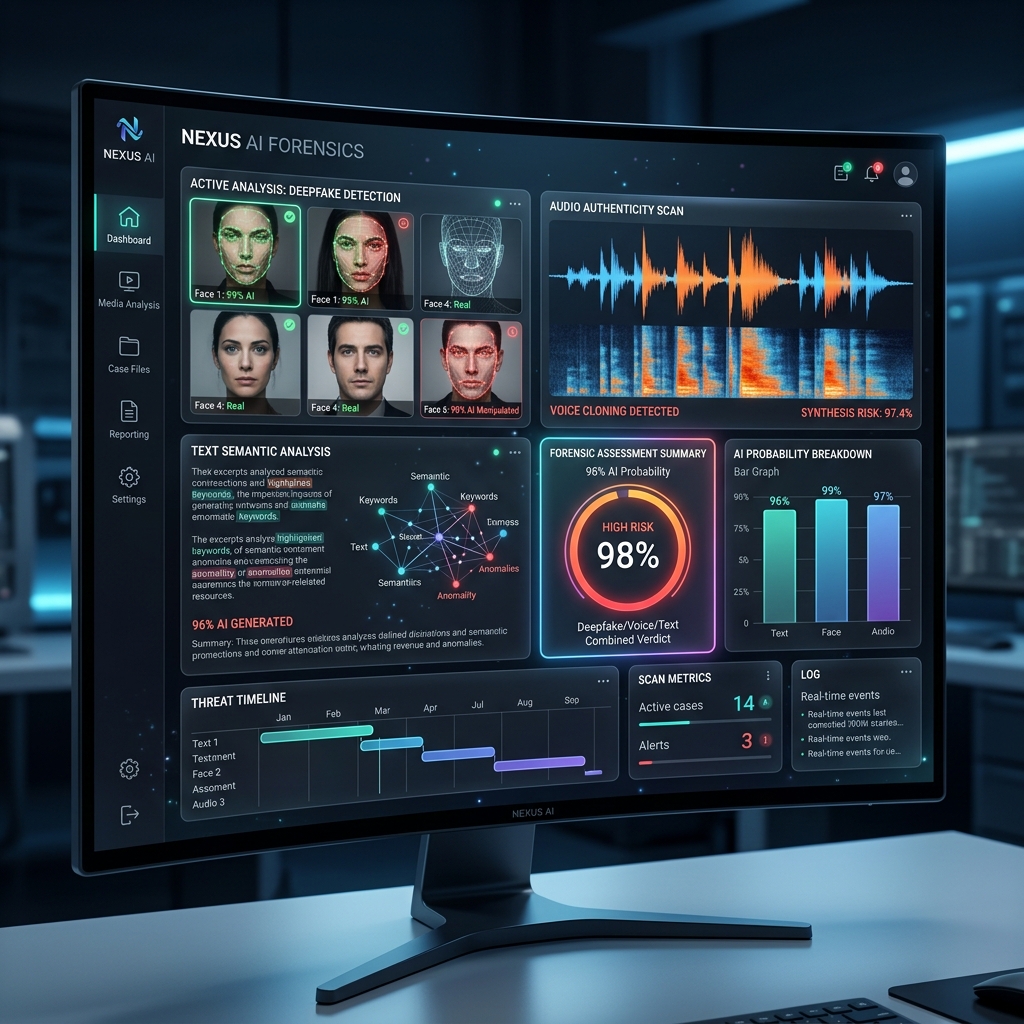
The Forensics Console Mockup
We are engineering a centralized verification dashboard. Designed to provide transparent forensic audits for cybersecurity teams, organizations, and developers.
API Integration
Developer-ready APIs to process video uploads, audio feeds, and document archives programmatically.
Verification Reports
Detailed cryptographic authentication documents detailing every anomaly detection indicator.